Barely two weeks after hosting a high-level livestock stakeholders’ engagement aligned with Nigeria’s livestock transformation agenda, the Kwara State Government has taken further concrete steps to translate policy dialogue into practical action under the Kwara Livestock Entrepreneurship Scheme (KWALES).

On January 29, 2026, the Kwara State Commissioner for Livestock Development, Hon. Oloruntoyosi Ayobola Thomas, led a strategic delegation on a technical visitation to Milkin Barn Agriserve Ltd., Fasola, Oyo State, a reputable dairy, grain, and pasture enterprise, as part of the state’s ongoing efforts to reposition its livestock sector in line with national reform objectives.

The visit builds directly on deliberations from the January 16 livestock stakeholders’ engagement, where the Federal Ministry of Livestock Development, represented by the Special Adviser to the Honourable Minister, Mr. Richard-Mark Mbaram, outlined the Federal Government’s vision of transforming livestock into a major contributor to Nigeria’s Gross Domestic Product within the next decade.

That engagement emphasized productivity, private-sector participation, technology adoption, and sub-national implementation as critical success factors.
Want to stay updated about everything in NIGERIA?
Click the button below to join our WhatsApp group...


Observers note that Kwara State’s rapid transition from dialogue to field-based learning reflects the leadership style of Governor AbdulRahman AbdulRazaq, whose administration has consistently prioritized agriculture and livestock as engines of inclusive growth, youth empowerment, and economic diversification.

The delegation to Milkin Barn included the Permanent Secretary of the Ministry of Livestock Development, Alhaji Yahaya Mohammed; Director of Livestock Services, Alhaji Umar; representatives of the Kwara State Ranchers Association; and AdunGreen Foundation, the Ministry’s appointed Technical Partner for KWALES.

At Milkin Barn, participants were taken through a comprehensive technical session led by the company’s management, detailing the realities of commercial dairy production in Nigeria. The presentation examined operational hurdles such as feed costs, infrastructure investment, animal productivity, and market access, alongside proven strategies that have enabled the enterprise to sustain production and integrate pasture, grain, and dairy systems.

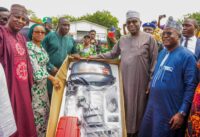
The engagement also featured a guided tour of the facility, exposing participants to structured animal housing, pasture development systems, feed management operations, and milk handling processes. A major highlight of the visit was a live demonstration of an Automatic Milking Machine, illustrating the role of mechanisation in improving efficiency, hygiene standards, animal welfare, and milk quality.

An interactive question-and-answer session followed, during which ministry officials, ranchers, and technical stakeholders explored the scalability of such models, the role of government policy in enabling private investment, and pathways for skills transfer to local producers.
Speaking during the visit, Hon. Toyosi Thomas reaffirmed the state’s commitment to building a modern, commercially viable, and inclusive livestock sector through KWALES. She noted that exposure to successful private enterprises is essential for designing programmes that respond to real industry conditions while creating opportunities for youth, women, and ranchers across the state.
According to her, KWALES is designed as a practical implementation vehicle for livestock reform in Kwara State, covering enterprise development, capacity building, technology adoption, and value-chain integration — all of which align with the broader objectives of Nigeria’s livestock transformation framework.
The Permanent Secretary, Alhaji Yahaya Mohammed, emphasized that such technical engagements strengthen institutional capacity and ensure that policies are informed by evidence and real-world experience, while the Director of Livestock Services, Alhaji Umar, highlighted the importance of pasture development and feed systems in improving productivity and reducing pressure associated with extensive livestock practices.
The presence of AdunGreen Foundationat the visitation reflects its role in supporting programme design, technical coordination, and knowledge exchange under KWALES. As Technical Partner, the Foundation works with the Ministry to bridge policy, innovation, and field-level implementation without displacing the responsibilities of government institutions or private operators.
Members of the Kwara State Ranchers Association described the visit as timely, noting that firsthand exposure to structured dairy and pasture systems would enhance their production decisions and investment outlook.
Analysts say the January 29 visitation demonstrates how Kwara State is positioning itself as a sub-national model for livestock reform by linking federal policy direction, state-level programmes like KWALES, credible private enterprises, and producer organizations.
As momentum continues to build from the January 16 stakeholders’ engagement, the Kwara State Government’s approach signals a deliberate shift from rhetoric to results — reinforcing Governor AbdulRahman AbdulRazaq’s vision of a transformed livestock sector that delivers jobs, food security, and sustainable economic growth.
Want to stay updated about everything in NIGERIA?
Click the button below to join our WhatsApp group...